5. Fractures: Bone Repair
A fracture is a broken bone. It will heal whether or not a physician resets (places) it in its anatomical position. If the bone is not reset correctly, the healing process will rebuild new bone but keep the bone in its deformed position.
When a broken bone is manipulated and set into its natural position without surgery, the procedure is called a closed reduction. Open reduction requires surgery to expose the fracture and reset the bone. While some fractures can be minor, others are quite severe and result in grave complications. For example, a fractured diaphysis of the femur has the potential to release fat globules into the bloodstream. These can become lodged in the capillary beds of the lungs, leading to respiratory distress and if not treated quickly, death (this is called a pulmonary embolism).
Types of Fractures
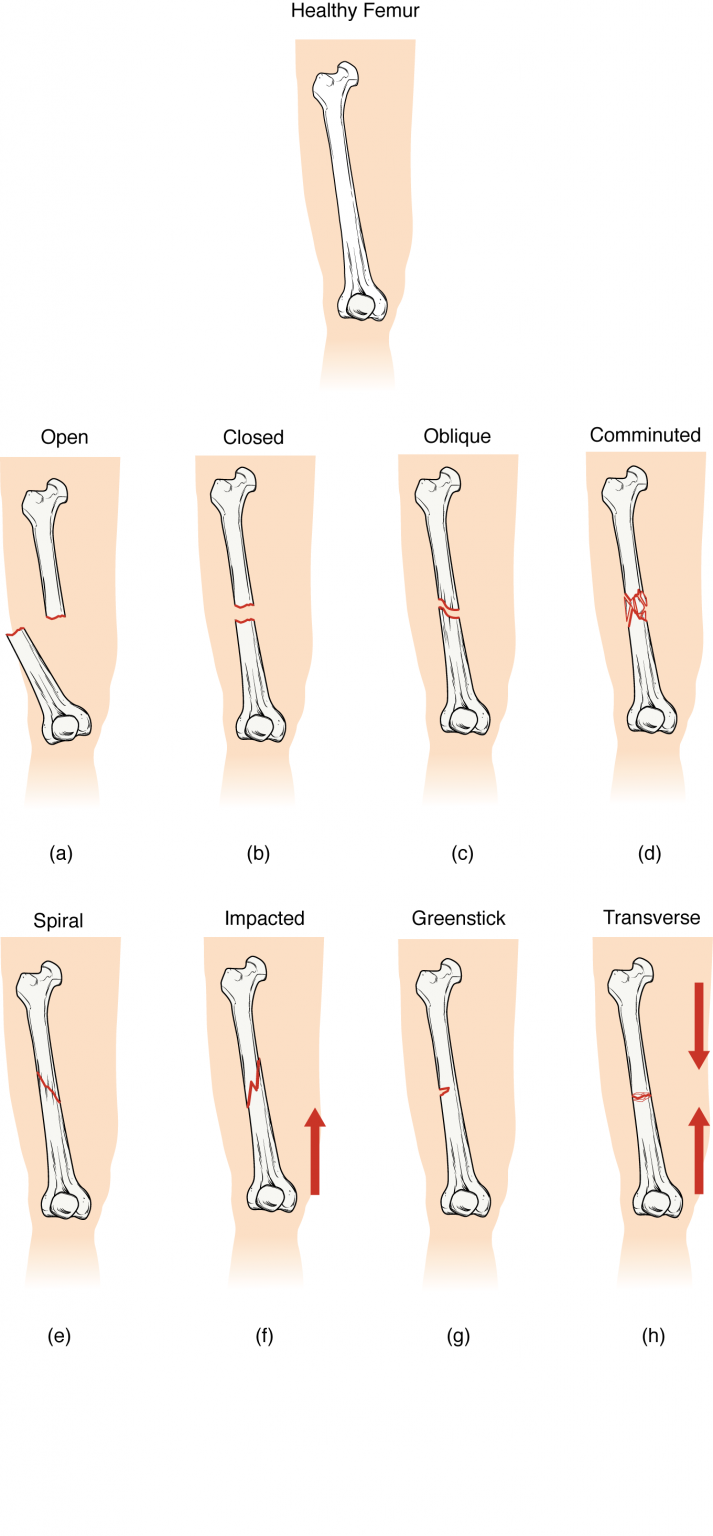
Fractures are classified by their complexity, location, and other features (see Figure 5.1). Table 4 outlines common types of fractures. Some fractures may be described using more than one term because it may have the features of more than one type (e.g., an open transverse fracture).
| Types of Fractures (Table 4) | |
|---|---|
| Type of fracture | Description |
| Transverse | Occurs straight across the long axis of the bone |
| Oblique | Occurs at an angle that is not 90 degrees |
| Spiral | Bone segments are pulled apart as a result of a twisting motion |
| Comminuted | Several breaks result in many small pieces between two large segments |
| Impacted | One fragment is driven into the other, usually as a result of compression |
| Greenstick | A partial fracture in which only one side of the bone is broken, often occurs in the young |
| Type of Fracture | Description |
|---|---|
| Open (or compound) | A fracture in which at least one end of the broken bone tears through the skin; carries a high risk of infection |
| Closed (or simple) | A fracture in which the skin remains intact |
Bone Repair
Depending on the type, severity of the fracture and distance between bone fragments, bones may heal directly by building new bone onto the fracture site (direct bone healing or contact healing) or may heal in a process like endochondral bone formation (indirect bone healing). Direct bone healing is essentially bone remodeling in which osteoblasts and osteoclasts unite broken structures. With indirect bone healing the process is more complicated and similar to endochondral bone formation in which broken bones form cartilaginous patches before regrowing new bone. In this process, blood released from broken or torn vessels in the periosteum, osteons, and/or medullary cavity clots into a fracture hematoma (see Figure 5.2a). Though broken vessels promote an increase in nutrient delivery to the site of vessel injury (see inflammation process in blood vessel chapter), the disruption of blood flow to the bone results in the death of bone cells around the fracture.
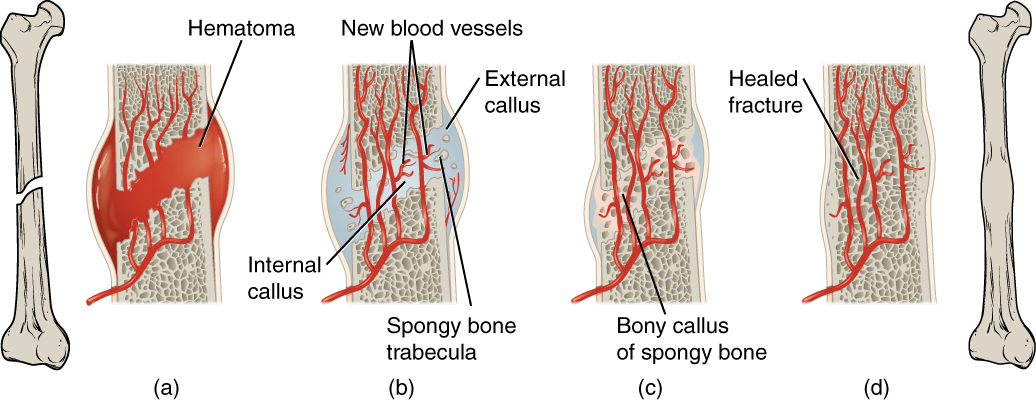
Within about 48 hours after the fracture, stem cells from the endosteum of the bone differentiate into chondrocytes which then secrete a fibrocartilaginous matrix between the two ends of the broken bone; gradually over several days to weeks, this matrix unites the opposite ends of the fracture into an internal callus (plural = calli or calluses). Additionally, the periosteal chondrocytes form and working with osteoblasts, create an external callus of cartilage and bone, respectively, around the outside of the break (see Figure 5.2b). Together, these temporary soft calluses stabilize the fracture.
Over the next several weeks, osteoclasts resorb the dead bone while osteogenic cells become active, divide, and differentiate into more osteoblasts. The cartilage in the calluses is replaced by trabecular bone via endochondral ossification (destruction of cartilage and replacement by bone) (see Figure 5.2c). This new bony callus is also called the hard callus.
Over several more weeks or months, compact bone replaces spongy bone at the outer margins of the fracture and the bone is remodeled in response to strain (see Figure 5.2d). Once healing and remodeling are complete a slight swelling may remain on the outer surface of the bone, but quite often, no external evidence of the fracture remains. This is why bone is said to be a regenerative tissue that can completely replace itself without scars.